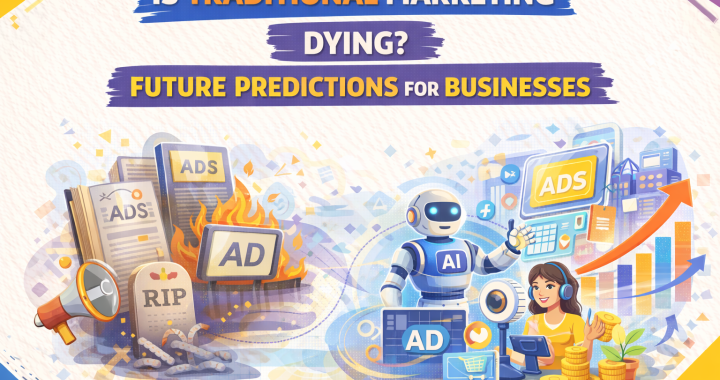
Is Traditional Marketing Dying? Future Predictions for Businesses
For decades, traditional marketing ruled the business world. Newspaper ads , TV commercials , radio jingles , hoardings, pamphlets, and word-of-mouth were the backbone of brand promotion. But today, businesses are asking a serious question:
Is traditional marketing dying?
With the rise of digital platforms, smart ads, AI, and data-driven strategies, the marketing landscape is changing faster than ever. At Ad Smart India, we believe the answer is not as simple as yes or no. Instead, marketing is evolving, and businesses that fail to adapt risk becoming invisible.
Let’s explore the future of traditional marketing and what lies ahead.
What Is Traditional Marketing?
Traditional marketing includes offline promotional methods such as:
Newspapers & magazines
Television commercials
Radio advertising
Billboards & hoardings
Flyers, brochures & posters
Event sponsorships
These methods were once highly effective when consumer attention was limited to a few media channels.
Why Traditional Marketing Is Losing Its Power
Traditional marketing is not dead—but it is losing dominance. Here’s why:
1. Changing Consumer Behavior
Today’s consumers spend most of their time on:
Smartphones
Social media platforms
Search engines
Streaming services
Younger generations rarely read newspapers or watch TV ads attentively. Attention has moved online.
2. Lack of Precise Targeting
Traditional marketing targets everyone, not the right audience.
Example: A newspaper ad reaches thousands, but only a small percentage may be interested.
Digital marketing, on the other hand, targets:
Location
Age & interests
Search intent
Online behavior
This makes traditional methods less efficient.
3. No Proper Performance Tracking
One of the biggest disadvantages of traditional marketing is poor measurability.
You can’t accurately track:
How many people noticed the ad
Who took action
What ROI you earned
In contrast, digital marketing offers real-time data, analytics, and conversion tracking.
4. High Cost, Lower ROI
TV commercials, print ads, and hoardings are expensive. For small businesses, these costs are often not justified by the results.
Digital marketing allows:
Budget flexibility
Better cost control
Higher ROI even with small budgets
This makes traditional marketing less attractive for growing businesses.
Does This Mean Traditional Marketing Is Dead?
No. Traditional marketing is not dead—it is transforming.
Traditional methods still work in certain situations:
Local brand awareness
Rural markets
Large-scale events
Trust-building campaigns
However, relying only on traditional marketing is no longer enough in today’s digital-first world.
Future Predictions for Traditional Marketing
Let’s look at how traditional marketing will evolve in the coming years.
1. Integration With Digital Marketing
The future is hybrid marketing.
Traditional marketing will work alongside digital strategies:
QR codes on hoardings
TV ads driving users to websites
Print ads promoting social media handles
Offline ads will act as entry points to online engagement.
2. Hyper-Local Traditional Marketing
Mass marketing will decline, while hyper-local targeting will rise.
Examples:
Local newspapers for specific areas
Area-specific hoardings
Community event sponsorships
This approach increases relevance and reduces wastage.
3. Focus on Brand Trust & Credibility
Traditional marketing still carries a sense of authenticity and trust.
In the future, it will be used more for:
Brand credibility
Reputation building
Long-term brand recall
Digital ads convert faster, but traditional marketing strengthens trust.
4. Reduced Frequency, Higher Quality
Instead of frequent traditional ads, brands will focus on:
Fewer but impactful campaigns
Creative storytelling
Strong messaging
Quality will matter more than quantity.
5. Traditional Marketing for Emotional Connection
Offline experiences like events, exhibitions, and physical branding create real-world emotional connections.
These experiences:
Build loyalty
Strengthen brand recall
Complement digital strategies
This emotional aspect will keep traditional marketing relevant.
The Rise of Digital-First Marketing
While traditional marketing adapts, digital marketing will continue to dominate.
Why?
Data-driven decisions
Smart targeting
AI & automation
Measurable ROI
Lower cost & higher scalability
Digital platforms allow businesses to grow faster and smarter.
What Businesses Should Do in 2025 & Beyond
To survive and grow, businesses must:
Stop choosing between traditional and digital
Start combining both smartly
A smart strategy includes:
Digital ads for leads & sales
Traditional methods for visibility & trust
Data-driven decision making
Consistent branding across all platforms
How Ad Smart India Helps Brands Adapt
At Ad Smart India, we help businesses move confidently into the future .
Our approach focuses on:
Digital-first advertising strategies
Smart targeting & analytics
Cost-effective campaigns
Blending offline insights with online execution
We help brands evolve, not struggle.
Final Thoughts
Traditional marketing is not dying—it is changing its role.
The future belongs to businesses that:
Adapt to digital trends
Use traditional marketing strategically
Focus on data, relevance, and ROI
Marketing is no longer about choosing old or new—it’s about choosing smart.
Ad Smart India– Smart Strategies for a Changing Marketing World