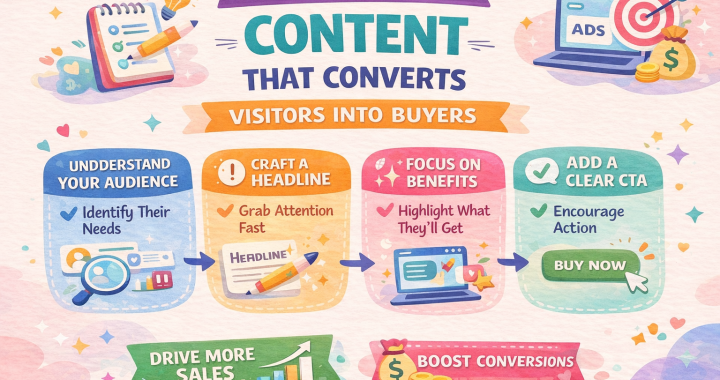
How to Write Content That Converts Visitors into Buyers
By AD SMART INDIA
Driving traffic to your website is important — but traffic alone doesn’t pay the bills. What truly grows a business is content that converts. You may have thousands of visitors, but if your words don’t persuade, engage, and guide them, they’ll leave without taking action.
At AD SMART INDIA, we believe content is not written to impress — it’s written to influence decisions. In this blog, we’ll break down how to write high-converting content that turns casual visitors into loyal buyers.
Why Most Website Content Fails to Convert
Many businesses focus only on:
Describing their services
Adding fancy words
Writing long paragraphs
Talking about themselves
But visitors ask only one question when they land on your website:
“What’s in it for me?”
If your content doesn’t answer this within seconds, conversions drop.
Step 1: Understand Your Audience Deeply
Conversion-focused content begins before writing.
Ask These Questions:
1. Who is my ideal customer?
2.What problem are they struggling with?
3.What are they afraid of losing?
4.What result do they truly want?
When your content feels like it’s reading their mind, trust is built instantly.
Pro Tip: Use the same words your customers use in WhatsApp chats, comments, and inquiries.
Step 2: Start With a Powerful Headline
Your headline decides whether visitors read further or leave.
High-Converting Headlines:
Address a pain point
Promise a clear benefit
Create curiosity
Keep it simple
Examples:
“Stop Wasting Money on Ads That Don’t Convert”
“How Businesses Generate Leads Without Increasing Budget”
A strong headline pulls visitors deeper into your content.
Step 3: Focus on Benefits, Not Features
Visitors don’t care what you do — they care how it helps them.
Feature vs Benefit:
“We provide SEO services”
“We help your website rank higher and bring consistent leads”
Always translate features into outcomes.
Rule: If a sentence doesn’t explain a benefit, rewrite it.
Step 4: Use Simple, Conversational Language
High-converting content feels like a conversation, not a lecture.
Best Practices:
Write as you speak
Use short sentences
Avoid complex jargon
Break content into scannable sections
People skim content — make it easy to read.
Step 5: Build Trust Through Proof
Without trust, conversions won’t happen.
Trust Elements to Include:
Client testimonials
Case studies
Real numbers and results
Brand logos
Clear contact details
Example: “We’ve helped 150+ businesses generate quality leads with smart ad strategies.”
Proof removes doubt and increases confidence.
Step 6: Guide Visitors With Clear CTAs
Content without a call to action is a missed opportunity.
High-Converting CTA Tips:
Use action-oriented words
Focus on value
Avoid confusion
Keep one primary action per page
Examples:
“Get a Free Consultation”
“Book Your Strategy Call”
“Start Growing Today”
A clear CTA tells visitors exactly what to do next.
Step 7: Use Psychological Triggers
Smart content uses psychology subtly.
Powerful Triggers:
Scarcity: “Limited slots available”
Social proof: “Trusted by 500+ brands”
Authority: “Industry-proven strategies”
Fear of loss: “Don’t lose potential customers”
Clarity: “3-step growth system”
These triggers motivate action without sounding salesy.
Step 8: Tell Stories, Not Just Information
Stories make content memorable.
How to Use Storytelling:
Talk about a client’s problem
Show the solution you provided
Highlight the transformation
Example: “A small business owner struggling with low leads saw 3X growth after optimizing their website content.”
Stories create emotional connection — and emotions drive buying decisions.